


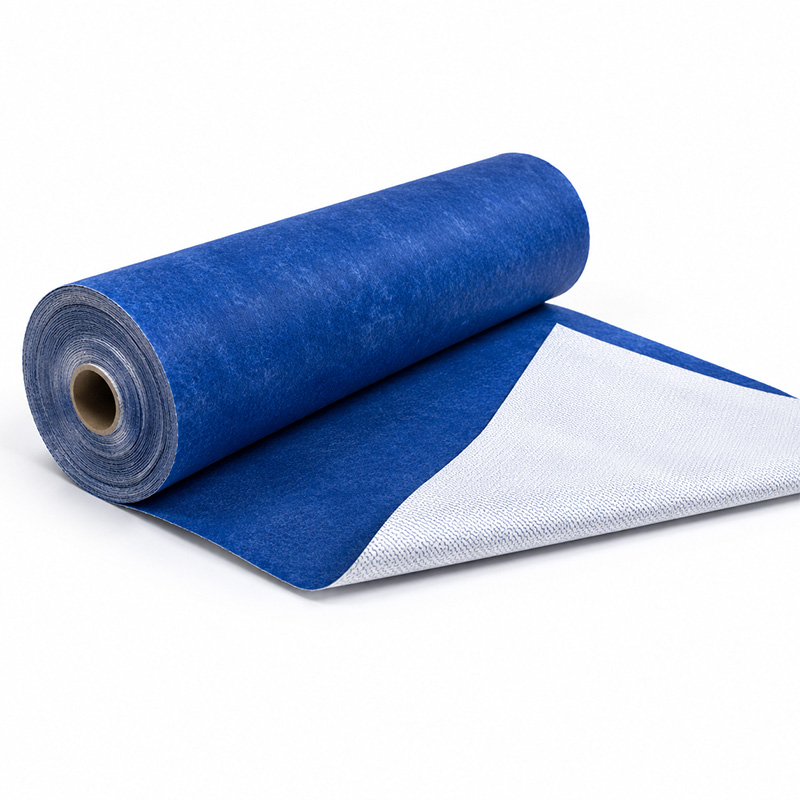
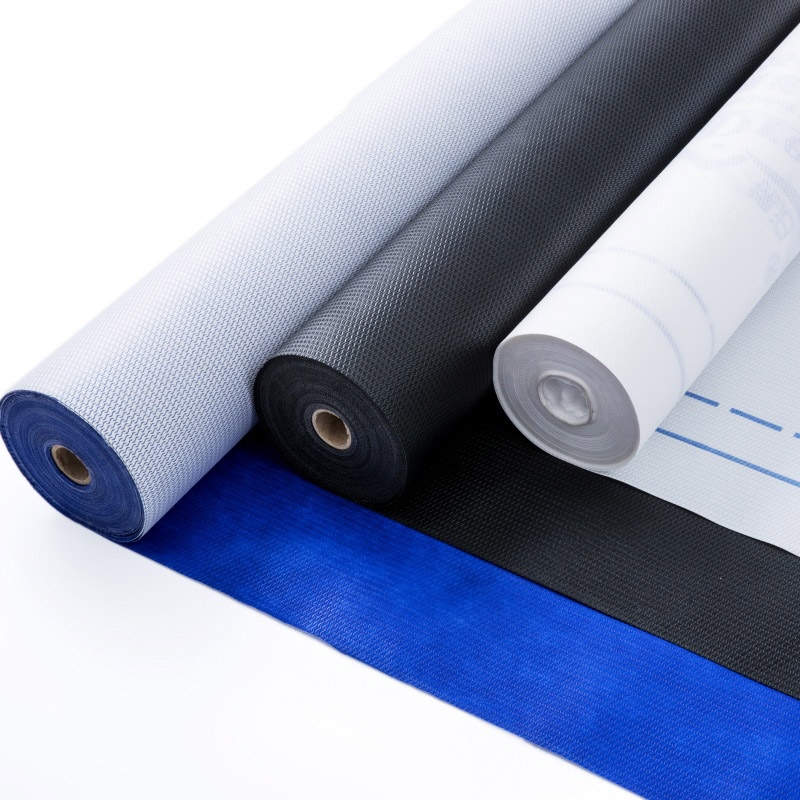
Breather Membranes For Buildings
Our breather membranes for buildings are three-layer hot-pressed WRB materials independently made by House-Dress. Exported since 2009, they adopt micropore technology to block rainwater while releasing internal vapor, preventing condensation and mold. Available for bulk wholesale with ASTM verified performance, good UV & tear resistance, ideal for steel buildings, villa tiled roofs and curtain wall enclosures.
House-Dress breather membranes for buildings are a functional building enclosure membrane material independently produced by Xiongxian XiaShi Packing.
We have started overseas export business since 2009. Large quantities of our building breather membranes have been sold to mainstream markets including Europe and Russia.
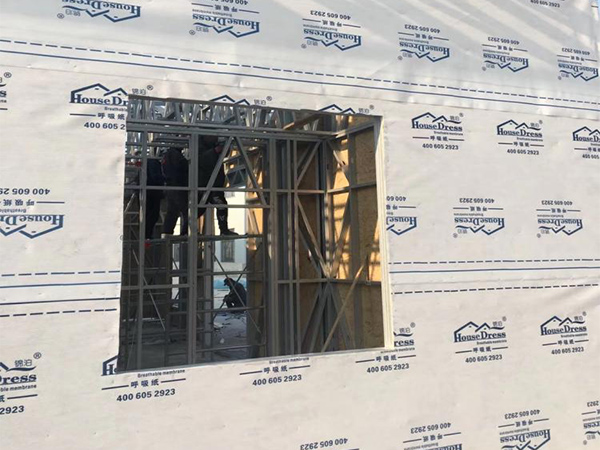
This product acts as a Weather-Resistive Barrier (WRB), widely used for steel-structure industrial workshops, villa tiled roofs, and curtain wall exterior wall systems.
Unlike conventional non-breathable PE plastic films, the breather membranes produced by XiaShi Packing Co., Ltd. leverage precise micropore physical characteristics.
It achieves the core performance of “preventing water ingress while allowing moisture vapor transmission”. This effectively solves common engineering problems including wall and roof condensation, mold growth, and thermal insulation layer degradation caused by long-term moisture accumulation.
Product Structure and Operating Principle
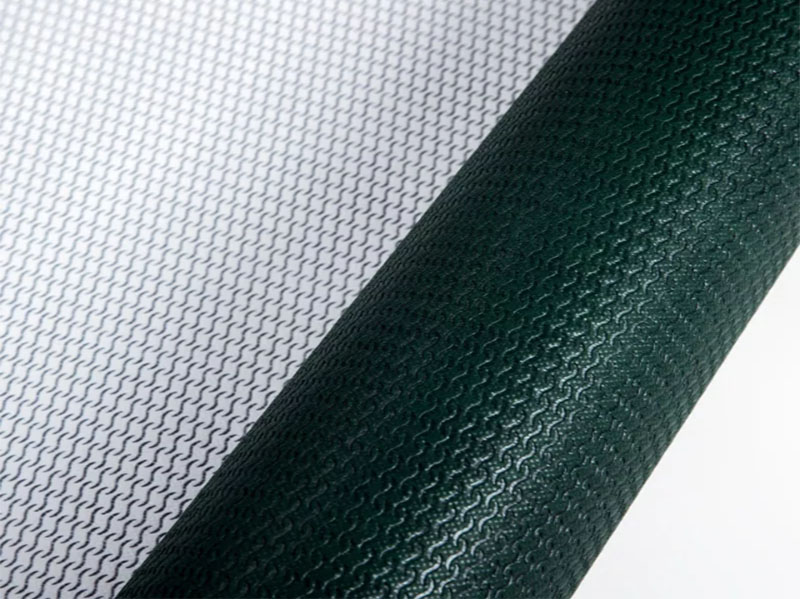
House-Dress breather membranes for buildings employ a three-layer spunbond polypropylene hot-press composite process with no secondary adhesive bonding.
Outer spunbond PP non-woven layer: Resists on-site abrasion and gravel damage, improving overall outdoor weather resistance.
Middle microporous functional membrane: The core functional layer responsible for water vapor exchange and waterproof performance.
Inner spunbond PP non-woven layer: Protects the functional core layer, enhances tensile strength and improves fastener-piercing tear resistance.
Based on micro-scale physical principles: the minimum diameter of a liquid water droplet is approximately 20 μm, while a water vapor molecule measures only 0.0004 μm.
Membrane micropores allow water vapor molecules to diffuse outward and escape. Meanwhile, water surface tension blocks liquid rainwater penetration, realizing stable waterproof and breathable performance.
Full Technical Specification
| Characteristic | Test Method | Results |
| Moisture vapor transmission | ASTM E96 | 10-20 Perms |
| Water proof | ASTM E96 | Pass |
| Tensile strength(N/50mm) | ASTM D751 | MD-290CD-220 |
| Elongation(%) | ASTM D751 | MD-55%CD-55% |
| Resistance to UV(month) | ASTM G154-06 | 6months |
| Air Permeance at 75 Pascals | ASTM E 2178 | 0.002L/S/Sqm |
Installation Notes
Breather membranes for buildings are professional functional materials for building envelope systems.
Final system performance depends not only on membrane quality, but also on standardized construction techniques, matching auxiliary materials and complete joint sealing.
Improper installation may cause water leakage, reduced vapor permeability, and shortened service life of the entire building envelope. Please strictly follow the on-site construction guidelines below.
1. Laying Direction and Installation Position
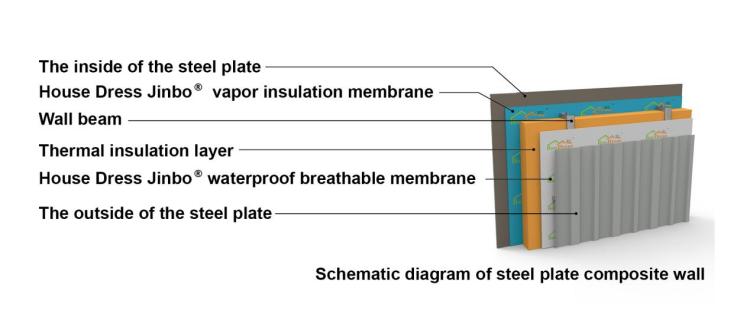
The breather membranes for buildings must be installed on the outer side of the insulation layer and never on the inner side.
A vapor barrier is required for the insulation inner layer. The two materials have different functions and cannot be used interchangeably.
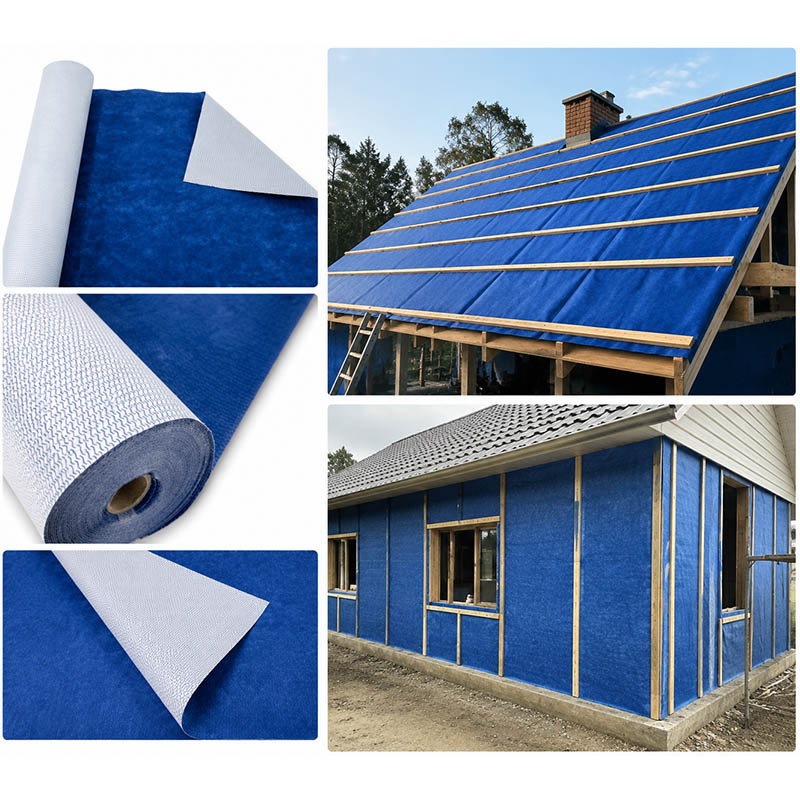
Roofing construction: Lay the membrane following the drainage slope. The upper layer must overlap and press the lower layer to avoid rainwater infiltration through seams. Reverse laying is strictly prohibited.
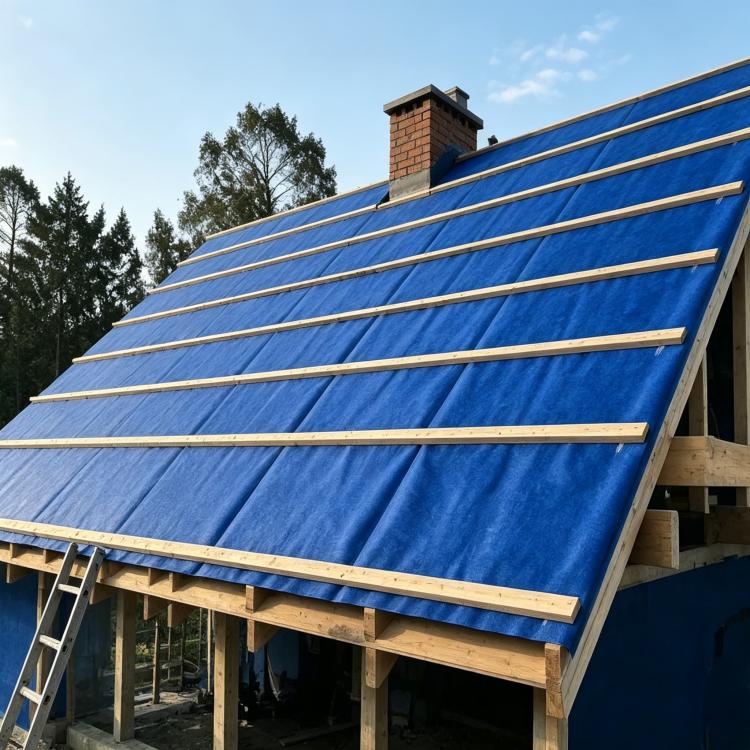
Wall construction: Lay the membrane horizontally with upper layers covering lower layers to ensure outward water drainage.
2. Mandatory Overlap Width Requirement
Horizontal and vertical overlap widths shall be no less than 100 mm.
For strong-wind, high-rainfall or high-altitude areas, the overlap width is recommended to be 150 mm.
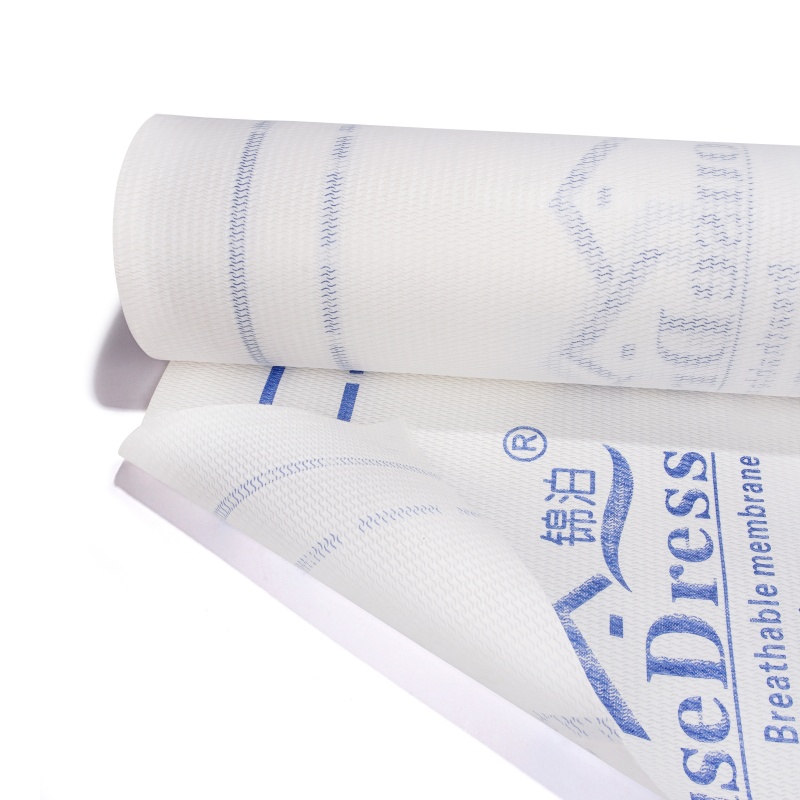
The blue dashed line on the membrane serves as the overlap reference line for convenient on-site construction.
All overlapping seams must be sealed with butyl overlap tape. Simple overlapping and single fastener fixation will leave water-permeable gaps.
3. Fixation Method and Nail Placement
Use large-head insulation fasteners and spacer fasteners for fixation. All fasteners must be equipped with rubber gaskets to prevent water ingress through nail holes.
Install fasteners within membrane overlapping areas instead of single-layer exposed areas to reduce leakage risks.
Drive fasteners with moderate force to avoid excessive membrane compression.
Any puncture, cutting or tearing damage must be fully repaired and covered with butyl tape before the next construction step.
4. Detail Node Treatment
Doors and windows: Fold the membrane over door and window frame flanges and fully seal with professional butyl sealing tape to prevent frame-gap infiltration.
Wall-penetrating pipes and vents: Fold and wrap the membrane upward around pipe openings, then seal with flexible flashing strips and butyl tape. Direct simple perforation is forbidden.
Internal and external corners: Adopt continuous folded membrane transition as much as possible to minimize corner seams. If seams are unavoidable, reinforce with extra membrane patches for better tightness.
FAQ
Q1: Can the breather membrane be installed in cold climate regions?
A: Yes. Our PP composite membrane maintains stable flexibility under low-temperature conditions, suitable for cold-area building envelope projects.
Q2: What delivery lead time for stock membrane orders?
A: Stock items can be shipped within 3–7 working days. Lead time for OEM custom orders will be confirmed upon your final drawing.
Q3: Can the membrane be cut easily on construction sites?
A: Yes. The material can be simply cut with utility knives on site, while all cut edges must be sealed properly for waterproof integrity.
Contact us today to discuss your project requirements and get your wholesale quotation.
Send Inquiry
Contact Info
-
Address
Xihouliu Industrial Zone Xiong County, Baoding City, Hebei Province, China
-
Tel
-
Unlock Tailored Solutions from a Premier China Manufacturer
Got condensation issues? Energy leaks? Share specs → get customized membranes/felts that:
• Reduce building energy costs by ≤40%
• Eliminate mold risk with SGS-verified waterproofing
• Cut noise pollution by 50dB (rain impact test data)


News Recommendations



 Miranda
 Miranda